
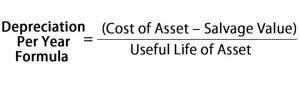
However, the useful life of these assets is shorter than that of buildings or machinery. The journal entry for depreciation in capital investments is similar to that of manufacturing, real estate, and technology. Journal entries for depreciation are necessary to record the decrease in the value of fixed assets over time. The Depreciation Expense Account is debited, while the Accumulated Depreciation Account is credited. These entries are adjusting entries made at the end of the accounting period. Depreciation is an What is bookkeeping important concept in accounting that reflects the reduction in the value of an asset over time.
Comprehensive Guide to Journal Entries on Depreciation
- On the balance sheet, the asset’s original cost is shown, less the accumulated depreciation, resulting in the net book value (or carrying value).
- The matching principle requires expenses to be recognized in the same period as the revenues they help produce.
- The method of depreciation used depends on the type of asset and the company’s accounting policy.
- To record this, you can post a journal to credit your balance sheet account and debit the overhead account.
- Companies can choose from several depreciation methods allowed under GAAP and IFRS, selecting one that rationally reflects how the asset’s economic benefits are consumed.
- This accounting method spreads the asset’s purchase cost across the periods it helps generate revenue, rather than tracking fluctuations in market value.
Double Entry Bookkeeping is here to provide you with free online information to help you learn and understand bookkeeping and introductory accounting. HighRadius is redefining treasury with AI-driven tools like LiveCube for predictive forecasting and no-code scenario building. Its Cash Management module automates bank integration, global visibility, cash positioning, target balances, and reconciliation—streamlining end-to-end treasury operations. HighRadius stands out as a challenger by delivering practical, results-driven AI for Record-to-Report (R2R) processes. On track for 90% automation by 2027, HighRadius is driving toward full finance autonomy. Let’s suppose a company buys equipment for $5,000 with a useful life of 5 years and zero salvage value.

Step 4: Update Financial Statements
Recording depreciation requires a journal entry based on double-entry bookkeeping, where total debits equal total credits. This entry is typically made as an adjusting entry at the end of an accounting period (monthly, quarterly, or annually) before preparing financial statements. Learn how to accurately record depreciation expenses, choose appropriate methods, and understand the accounts involved for clear and compliant financial reporting. Depreciation is a critical aspect of bookkeeping that impacts Cash Flow Management for Small Businesses your financial statements, tax obligations, and asset management. By understanding and applying the right depreciation methods, you can ensure compliance, maximize deductions, and maintain accurate records.
- PP&E refers to a company’s tangible, long-term assets that are used in the production of goods or services.
- Suppose your business purchases office furniture for SAR 45,000 on January 1.
- Another accelerated method that applies a decreasing fraction to the depreciable base.
- Another important concept is the difference between book value and market value.
- Accumulated depreciation, on the other hand, is the total depreciation recorded for an asset since it was acquired.
- For example, an asset purchased on the 10th of June would result in two-thirds of a month’s depreciation for June.
Methods of Calculating Depreciation
PP&E refers to a company’s tangible, long-term assets that are used in the production of goods or services. Examples of PP&E include buildings, machinery, equipment, and vehicles. Depreciation is used for tangible assets such as buildings, machinery, and equipment.
Advance Your Accounting and Bookkeeping Career

The furniture has a useful life of 5 years and a SAR 7,000 salvage value. You’ve chosen the straight-line depreciation method, which spreads the cost evenly over the asset’s useful life. Both of these reflect on the income statement and affect the net income of the company.

Each method has its own unique set of journal entries that must be recorded in order to properly account for the depreciation expense. Depreciation is an important concept in accounting that refers to the reduction in the value of an asset over time due to wear and tear, obsolescence or other factors. It is a non-cash expense that is recorded in the financial statements of a company to reflect the reduction in the value of its assets. The sum-of-the-years’ digits method of depreciation is another accelerated method of depreciation.

Depreciation on Sale or Disposal of Assets
Depreciation is a method of allocating the cost of a fixed asset over its useful life. Fixed assets are long-term assets that are used in the production of income, such as machinery, equipment, buildings, vehicles, furniture, and plant and machinery. The purpose of the journal entry for depreciation is to achieve the matching principle. In each accounting period, part of the cost of certain assets (equipment, building, vehicle, etc.) will be moved from the balance sheet to depreciation expense on the income statement. The goal is to match the cost of the asset to the revenues in the accounting periods journal entry to record depreciation in which the asset is being used.
Recent Comments